

Custom Homes in Williston ND: Trends, Costs & What Homeowners Need to Know
Building a custom home in Williston, North Dakota, requires balancing high thermal efficiency needs with local market conditions where costs typically range between $200 and $350 per square foot. Success depends on securing a lot with proper utility access and designing a structure that withstands extreme temperature variances while adhering to zoning laws defined by the City of Williston Building Safety Department. Property owners must account for the shorter construction season in the Bakken region and plan for frost-depth compliant foundations to prevent structural heaving.
This guide analyzes the financial and logistical realities of residential construction in Western North Dakota. WBP CONTRACTING LLC provides this breakdown to help landowners and prospective builders make educated choices about development in Williams County.
Market Realities and Cost Factors in Williston
Construction in the Williston Basin operates differently than in other parts of the Midwest due to the influence of the energy sector on labor availability and material logistics. Understanding these costs upfront prevents budget overruns.
Cost Per Square Foot Breakdown
While national averages for custom homes sit lower, building in Williston often commands a premium. This is due to the need for specialized cold-weather materials and the competition for skilled tradespeople. A basic custom build starts near $200 per square foot, while luxury finishes or complex architectural designs push prices above $350 per square foot.
According to data from the National Association of Home Builders, construction material prices have remained volatile. In North Dakota, concrete and lumber carry additional transport costs. Future homeowners should secure fixed-bid contracts whenever possible to mitigate material price spikes during the build.
Comparison of Construction Types
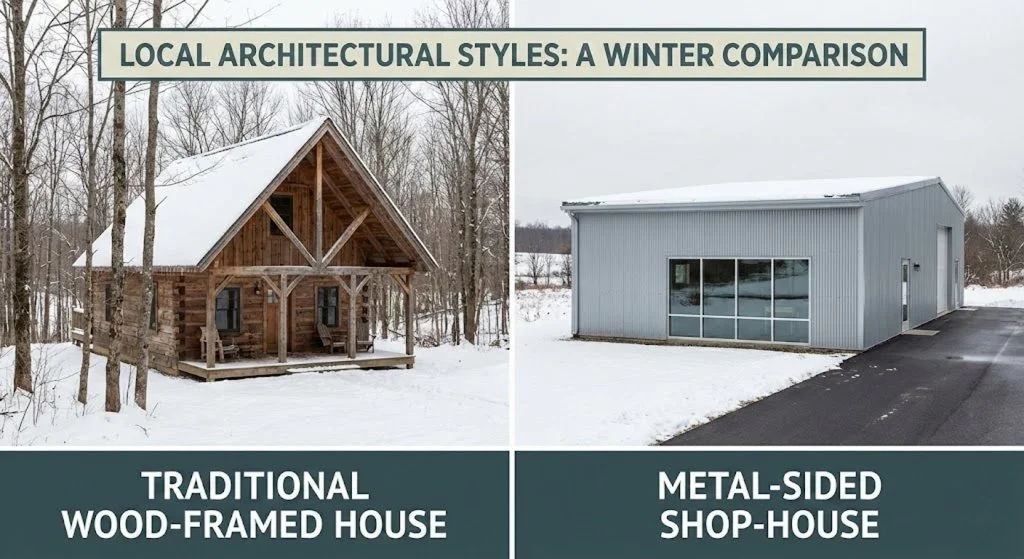
Prospective builders often weigh stick-built homes against "shouses" (shop-houses) or barndominiums, which are increasingly popular in rural North Dakota.
| Feature | Traditional Stick-Built | Barndominium / Shouse | Modular / Prefab |
|---|---|---|---|
| Primary Structure | Wood framing on concrete foundation | Post-frame (wood or steel) on slab | Factory-built sections |
| Cost Efficiency | Medium to High | High (if simple design) | Medium |
| Insulation Potential | Good (with 2x6 framing) | Excellent (deep wall cavities) | Variable |
| Resale Value | High stability | Niche market appeal | Lower appreciation |
| Build Timeline | 6–10 Months | 4–8 Months | 3–6 Months |
| Best For | City lots, subdivisions | Rural acreage, large toy storage | Rapid occupancy needs |
Current Design Trends in Western North Dakota
Homes in Williston must perform two functions: protect against harsh winters and provide comfortable living spaces during hot summers. Design trends here prioritize function and durability.
The Rise of the "Shouse"
The "shop-house" combination is dominating rural residential construction. This design combines a large, heated workshop with residential living quarters under a single roof. It suits the lifestyle of many Williston residents who need indoor storage for boats, campers, or work trucks to keep them out of the elements.
High-Performance Insulation
Standard 2x4 wall construction is becoming obsolete in this region. Builders now favor 2x6 framing or double-stud walls to accommodate thicker insulation. Spray foam insulation is the standard for sealing air gaps. The U.S. Department of Energy recommends distinct R-values for Zone 7 (which includes North Dakota), suggesting R-49 to R-60 for attics and R-21 or higher for walls to maintain efficiency.
Mudrooms and Transition Spaces
Building a home in Williston, ND requires careful planning, and a dedicated mudroom is not a luxury here; it is a necessity. Designs now feature expanded transition zones between the garage and the main living area, including heavy-duty flooring, drains for melting snow, and ventilation systems to dry wet gear.
Bonus Tip: Install a floor drain in the garage and the mudroom. North Dakota winters bring in significant snow melt, and managing that water prevents damage to interior finishes.
Things to Consider Before Making a Decision
Smart planning before breaking ground saves significant time and money.
Soil Conditions and Foundations
The soil in Williams County can vary from sandy loam to expansive clay. Clay expands when wet and shrinks when dry, which wreaks havoc on foundations. A geotechnical soil test is mandatory. Based on the results, engineers may recommend over-excavation (replacing bad soil with gravel) or helical piers to stabilize the structure.
Utility Access in Rural Areas
Building outside city limits requires securing water and power. Rural water memberships can have long waitlists or high tap fees. If rural water is unavailable, drilling a well is the alternative, but water quality varies. Septic systems require a percolation test to determine the size of the drain field.
The Weather Window
Excavation becomes significantly more expensive once the ground freezes. The ideal window to pour concrete foundations in Williston is between May and late October. Starts scheduled for November often incur "winter condition" charges for ground thawing and concrete additives.
Common Questions on Custom Building
Is financing a custom home different from buying an existing one?
Yes. You need a construction loan, which functions as a short-term line of credit during the build. You pay interest only on the amount drawn. Once the home is complete, this converts into a standard mortgage. Banks generally require a higher down payment (often 20%) for construction loans.
How does zoning affect my build?
The City of Williston enforces specific setbacks and height restrictions. If you build in the "ETJ" (Extra-Territorial Jurisdiction) just outside city limits, city codes may still apply. Always verify the zoning district before purchasing land.
Frequently Asked Questions
How to get a general contractor license?
To get a general contractor license, you must meet your state’s eligibility requirements, submit an application, pass the required exams, and provide proof of experience or education. Most states also require a background check, business registration, and liability insurance before issuing the license.
How do I get a general contractor's license?
You can get a general contractor’s license by applying through your state’s licensing board, proving your work experience, passing trade and business exams, paying the required fees, and submitting any needed documents such as insurance or bonding. Once approved, you’ll receive your license and can legally operate as a contractor.
How to get a general contractor’s license in California?
To get a general contractor license in California, you must apply through the Contractors State License Board (CSLB). Requirements include being at least 18 years old, having four years of journeyman-level experience, passing two exams (Law & Business + Trade), submitting fingerprints for a background check, and providing proof of a contractor bond and workers’ compensation (if applicable).
How much do general contractors charge?
General contractors typically charge 10% to 25% of the total project cost, depending on the size, complexity, timeline, and location of the job. Some may charge a flat rate or an hourly fee, but most work on a percentage-based markup that covers project management, coordination, labor, and overhead.
How to hire a general contractor?
To hire a general contractor, start by researching licensed and insured professionals, checking their reviews, verifying past work, and requesting multiple detailed quotes. Ask about timelines, warranties, contracts, and communication processes. Always choose a contractor who provides a written agreement and clearly explains costs, scope, and expectations.
Bonus Tip: Request a "Blower Door Test" at the end of construction. This diagnostic test measures the airtightness of the home and verifies that the insulation and sealing work meets high-performance standards.
Final Thoughts on Building in the Bakken
Building a custom home in Williston is a significant investment that pays off through tailored design and superior energy performance. Success requires respecting the local climate, understanding the soil, and budgeting for the specific labor dynamics of the region. Focus on structural integrity and thermal efficiency first; aesthetic upgrades can happen later, but a frozen pipe or cracked foundation is expensive to fix. Evaluate your long-term goals and ensure your chosen site supports the scope of your project.
Start Your Project
Reliable construction requires a partner who understands the local terrain and codes. WBP CONTRACTING LLC delivers precision and transparency for your development needs.
Contact Us:
Phone: (406) 890-3507
Email: wilder@wbpcontracting.com
Reach out today to discuss your project specifications and secure your place in the construction schedule.
Sources
National Association of Home Builders - National Association of Home Builders,
U.S. Department of Energy - U.S. Department of Energy
City of Williston - City of Williston
